
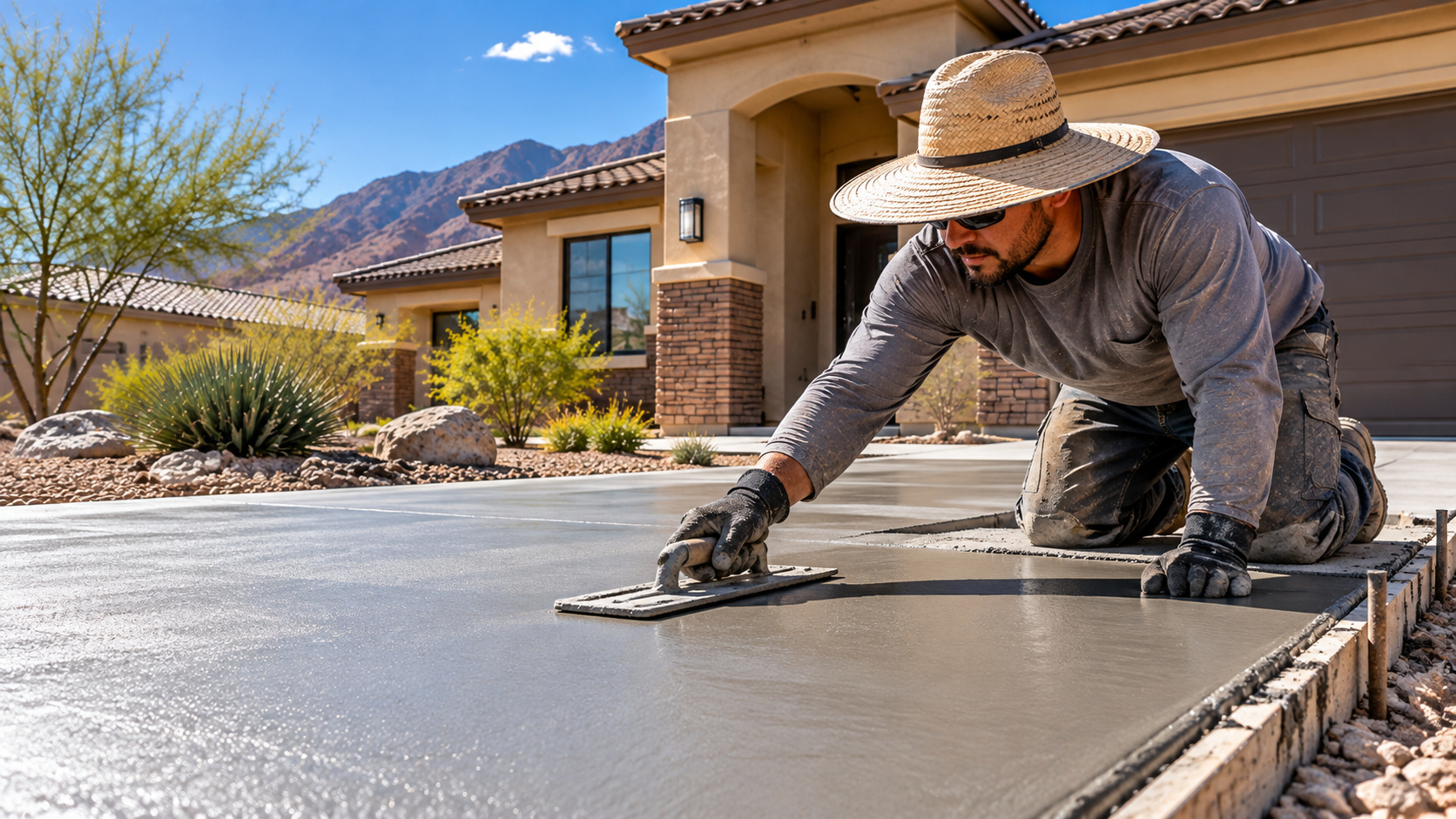
Desert Placement
What Hot-Weather Concreting Means
The American Concrete Institute describes hot-weather concreting in terms of conditions that can impair fresh or hardened concrete, including high ambient temperature, high concrete temperature, low relative humidity, wind speed, and solar radiation. In the Las Vegas Valley, several of those factors can occur together.
The risk is not simply that workers feel hot. Faster evaporation and accelerated hydration can reduce finishing time, increase water demand if the mix is handled poorly, and increase the potential for plastic-shrinkage cracking and other surface problems.
Why Low Humidity and Wind Matter
Evaporation is driven by more than the air-temperature number. Dry air and wind can pull moisture from a fresh surface quickly, especially when the concrete itself is warm. That is why a breezy dry day can demand attention even when it is not the hottest day of the season.
Crews monitor actual conditions and adapt placement, finishing, and curing rather than relying on a calendar rule.
Planning Strategies
Hot-weather planning can include scheduling placement earlier, coordinating deliveries so trucks do not sit unnecessarily, preparing forms and reinforcement before concrete arrives, having enough labor for the placement size, using appropriate mix and temperature-control practices, protecting the surface from rapid moisture loss, and beginning curing promptly.
The correct combination depends on the concrete supplier, mix, surface, size, weather, and specification. Homeowners do not need to prescribe the technical method, but they should expect hot-weather conditions to be part of the project plan.
Place when conditions are more manageable rather than automatically choosing the hottest part of the day.
Complete forms, base, reinforcement, embeds, and access before the truck arrives.
Match crew size and workflow to the placement area and finish complexity.
Use appropriate protection and curing to limit rapid surface drying.
Supplier and project practices can address material temperature when needed.
Stamped or detailed work adds steps, so available working time matters even more.
Curing Is Part of the Work
Concrete continues developing after finishing. Curing practices help maintain conditions that support hydration and strength development. In hot, dry weather, delaying curing or allowing the surface to dry too quickly can undermine the work that went into placement and finishing.
The curing method should fit the slab, finish, weather, and any decorative system. A decorative surface may have different product requirements from a basic broom-finished driveway.
What This Means for North Las Vegas Homeowners
A hot day does not automatically mean concrete cannot be placed, and a mild morning does not eliminate every risk. The point is to treat conditions as a real project variable. Ask how the crew plans timing, placement, finishing, and curing for the forecast and the surface being built.
For large or decorative pours, logistics are especially important because there is more area to place and finish before conditions change.
Weather-Aware, Not Weather-Panicked
Hot-weather concrete is a recognized construction condition with established planning practices. The useful question is how the project will be managed, not whether desert concrete is impossible.
Official Sources and Further Reading
Rules and fees can change. Confirm current requirements with the responsible agency for your specific property and project.